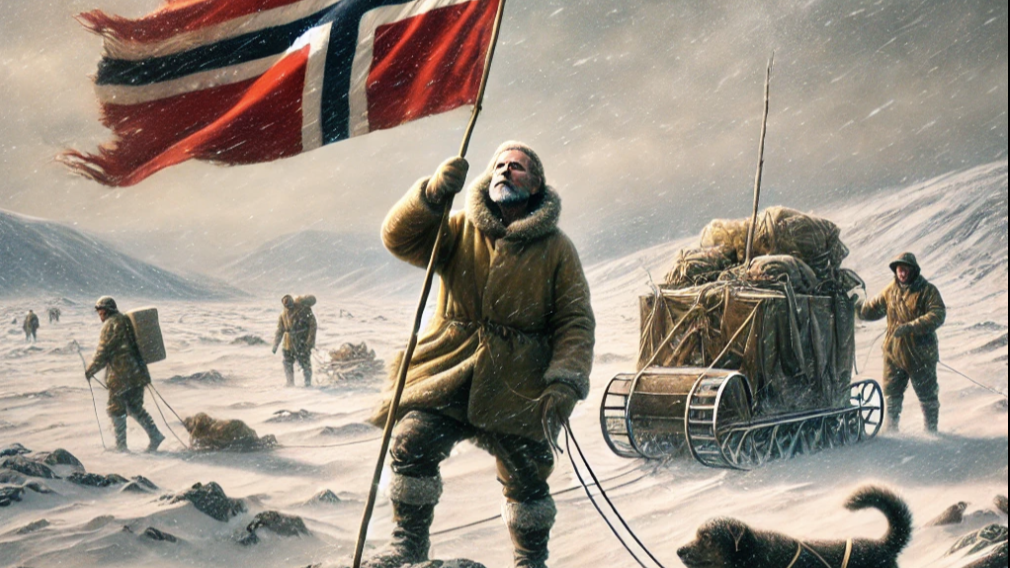
In January 1912, Robert Falcon Scott reached the South Pole and found a Norwegian flag already planted in the ice.
Roald Amundsen had beaten him by thirty-four days.
Scott and his four companions turned and began the return journey. None of them survived it.
The two expeditions had set out within months of each other in 1910, with comparable funding, comparable equipment, and leaders of comparable courage and determination.
The race was not decided by weather, or timing, or bad luck, though all three played their part.
It was decided earlier, before either expedition left the harbour, during the team selection process.
Amundsen's approach was specific to the point of obsession. He needed people who could ski, who understood dogs in extreme terrain, who had spent time in polar conditions, and who could make independent decisions under pressure without needing direction.
He did not hire for rank, or social standing, or institutional affiliation.
He hired for the precise capabilities that the precise mission demanded. When he reached the Pole and turned for home, every member of his team returned safely.
Scott's selection drew on different criteria. He was a Royal Navy officer from a tradition that valued rank, seniority, loyalty, and the kind of social credibility that would make the expedition respectable in the eyes of the Admiralty and the press.
His men were brave, committed, and, in the contexts where they had built their reputations, accomplished.
They were not built for what they were about to face. The environment they encountered did not care about the criteria used to select them. It only responded to the criteria Amundsen had used.
Most medtech companies making their first post-clearance commercial leadership hire are in exactly Scott's position.
And they do not know it yet.
The candidates on the shortlist are accomplished. Their CVs show revenue growth at companies the board has heard of, sector experience in adjacent therapeutic areas, and a network of hospital relationships that, on paper, closely match what the role requires.
The selection criteria feel rigorous because they draw on genuine evidence of performance.
The problem is that the evidence comes from a different environment. And that environment doesn't care.
A post-clearance medical device company is not the commercial world where those candidates built their reputations. There is no established purchasing pathway. There are no contracted relationships to lean on. Most of the surgeons who will eventually need to change their clinical practice to adopt the device have never heard of it.
The commercial infrastructure doesn't exist, so the commercial leader's role isn't to operate within it.
It is to build it from nothing, against a timeline that the board treats as fixed and the market treats as irrelevant.
That is a specific set of demands. It requires a specific profile. And the CV does not reveal whether the candidate has it.
CEB research across more than 6,000 B2B sales professionals found that the most commonly hired commercial profile, the one that is relationship-first, low on confrontation, and built for environments where the customer already understands the category, is the weakest performer in exactly this kind of complex, high-uncertainty selling environment.
Not because these are poor candidates.
Because their entire commercial operating model is built around avoiding the tension this environment specifically requires.
Scott did not hire bad people. He hired accomplished people whose capabilities did not match the environment they would face. The failure was not in the candidates. It was in the selection criteria applied to a mission whose specific demands had never been clearly defined before the search began.
The question worth asking before the next commercial leadership brief is written is not who has done this job before.
It is what this job actually demands, assessed directly rather than inferred from a track record built elsewhere entirely.
The two questions produce different shortlists. In conditions that genuinely test the people you hire, they produce different outcomes.
Scott's team did not fail. They were the wrong team for the right mission, selected by criteria that had always worked and did not work here.
That is a harder failure to see coming than simple incompetence, which is precisely why it keeps happening.
When you brief your next commercial leadership hire, what criteria are you actually using to define the role, and who in the room is challenging whether those criteria fit the environment you are entering, not the one you came from?