
Not the way you wrote it.
They're scanning. Looking for a reason to keep reading or a reason to stop. That decision happens in roughly 20 seconds, and most CVs don't survive it. Not because the career isn't strong, but because the document is designed for careful reading in a world of hurried skimming.
I've been on the other end of this for 30 years. I've seen CVs from people who were almost certainly the right person for the role. They didn't get called. The CV buried what mattered in the wrong place, or assumed the reader would work for it. They won't. They can't. Not when there are 700 of you.
The CV's only job is to get you to the next conversation. That's it. It doesn't close the hire. It doesn't prove you're exceptional. It just has to be clear enough, fast enough, to earn a phone call.
Write for the reader at speed, not the reader at leisure
The first person who sees your CV is probably not the person you'll eventually work for. They're a gatekeeper: efficient, time-pressured, looking for a fast yes or a fast no. A 10-page CV full of responsibilities and duties written in dense paragraphs is a fast no.
What gets through: a professional summary at the top that answers the job description before the reader has to search for evidence. If the role asks for five years of orthopaedic sales experience and you have eight, your first line should say so. Plainly. "Medical device sales professional with eight years of orthopaedic experience." Done. They read on.
For sales roles: products sold, customer type, performance. If those three things aren't visible in the first 30 seconds, you've made the reader work. They won't.
For regulatory professionals: 510(k), PMA, De Novo, 21 CFR part references, MDR 2017/745. Recruiters search for these on LinkedIn. If they're not on your CV, you're invisible to the search before anyone even opens the document.
For senior leaders: the business you walked into, the business you walked away from, and the gap in between. Numbers, if you have them. Funding raised, revenue grown, teams built. Boards think in before-and-after. Your CV should too.
The thing that costs nothing and almost no one does
I advertised a role once. Seven hundred applications came in.
One person applied through the proper channel and then sent a short email the same day. Just confirming they'd applied. Just saying why they actually wanted this particular position.
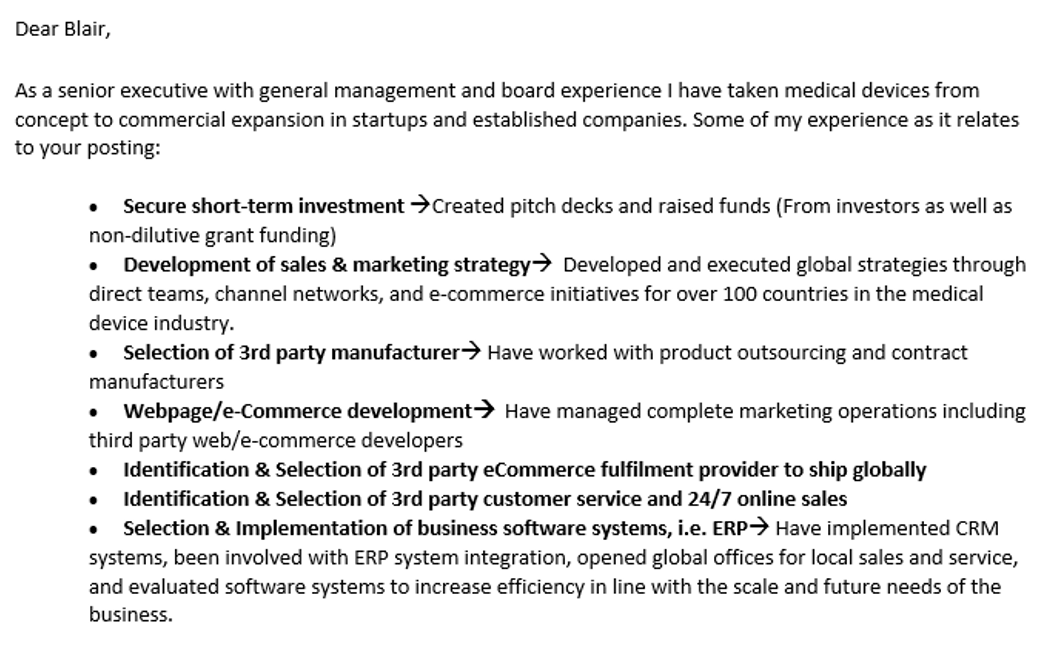
I called them first.
Not because the email said anything extraordinary. Because it was the only one. Because following up after you've applied is so rare that when someone does it, they immediately become a person rather than a number in a system. That's the whole trick. Become a person.
Your CV can get you noticed. Following up reminds them you're there.