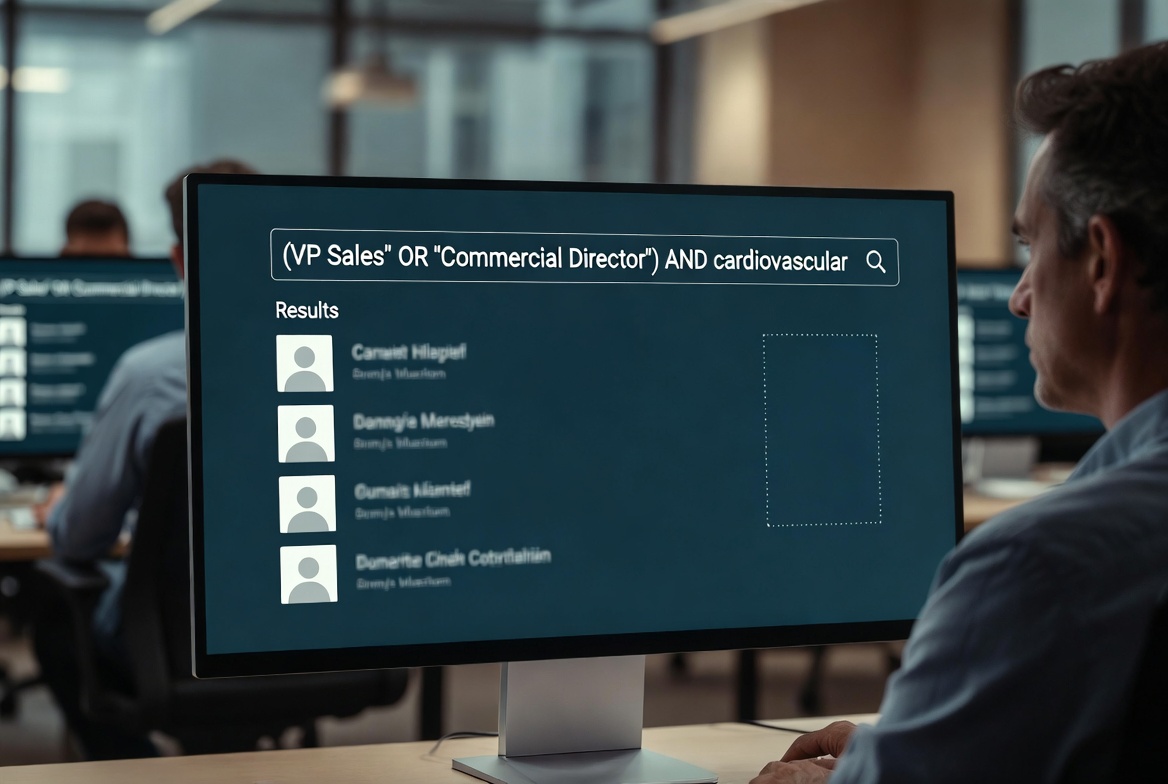
I want to be specific about something.
In the last six months, I've run active retained searches for a VP of Sales at a Series B cardiovascular startup, a Market Access Director at a structural heart company entering the UK, and a Commercial Director at a post-MDR orthopaedic firm rebuilding its European distribution model. Three companies. Three briefs. Roughly 280 combined results across the searches.
I know at least a dozen people who should have been in those results. They weren't. Not because they lacked the track record. The words weren't there.
This is not a career advice article. It's a technical brief on how a retained search actually runs, and what it means for your profile. The two things are different, and confusing them is expensive.
The machinery, plainly stated
LinkedIn Recruiter Professional is not the same as LinkedIn. It's a separate product with a different search architecture.
The keyword filter searches your entire profile: headline, summary, experience descriptions, skills, and education. Boolean operators (AND, OR, NOT) combine terms with precision. When I'm running a search for a cardiovascular VP Sales, the string looks something like:
("VP Sales" OR "Vice President Sales" OR "Commercial Director") AND (cardiovascular OR "structural heart" OR "transcatheter" OR "electrophysiology") NOT (aesthetics OR dental OR consumables)
Filters for job title, location, company, skills, industry, and spoken language all run on the same Boolean logic. "Must Have" is AND. "Can Have" is OR. "Doesn't Have" is NOT.
Zero of those terms in your profile means zero results. Not a low ranking. Absent.
The quality of your commercial track record is invisible until the algorithm surfaces you. That's the part that matters, and the part that most LinkedIn advice never reaches.
What to fix, in the order that it matters
Your headline. It's processed before any human reads it. The headline carries the most weight in the algorithm. It's the first field Boolean search scans. If your company gave you a title that nobody outside the company would search for, your headline needs to translate it into standard market language. "Commercial Growth Champion" doesn't appear in any search string I've ever written. "VP Sales | Medical Devices | Cardiovascular" appears in almost all of them.
120 characters. Standard title. Therapy area or device category. Seniority. That's the formula.
Your experience entries. Every role description is a Boolean landing zone. "Responsible for commercial activities across the UK" is not. "Led an eight-person UK field sales team for a transcatheter mitral valve repair programme, growing procedural volume 40% in 24 months through KOL development and clinical evidence dissemination" answers searches for transcatheter, mitral, structural heart, clinical adoption, UK, sales leadership, and KOL. It also answers the hiring manager's actual question: at what scale, in which device category, doing what?
Do this for every role in the last decade. Vague descriptions are invisible descriptions.
Your Skills section. It's directly searchable in LinkedIn Recruiter. An empty or sparse Skills section means you don't appear in filtered searches. List every therapy area, commercial function, and market access term that's relevant to your work. Market Access. Reimbursement Strategy. Health Technology Assessment. CPT code strategy. Commercial Launch. Distributor Management. These are the filter terms used by a retained search firm. If they're not there, the filter removes you.
Open to Work: recruiter-only mode. Almost nobody knows this setting exists. Activating Open to Work in recruiter-only mode places you in Spotlight categories within LinkedIn Recruiter, which candidates respond to at three times the rate. Recruiters prioritise these candidates when building initial shortlists. Your employer sees nothing. The recruiter sees you're open. It changes who makes the list.
Your About section. The algorithm already surfaced you. The human now has ten seconds. The About section is the difference between "interesting" and "next profile." Write it in the first person. Specific sector, specific function, specific outcome, brief signal about what you'd consider next. Not a press release. Not a list of adjectives. The way you'd introduce yourself in a room where nobody knows who you are.
The thing that actually moves the needle
Most of this is a single afternoon's work if you approach it with a clear brief rather than a vague intention to "clean up the profile." The brief is: would this profile appear in a Boolean search for the role I want next? If you don't know what that search string would look like, look at three job descriptions at your level and pull the common titles, therapy areas, and function terms. Those are the words.
One observation from running these searches consistently since 2019: the candidates who are hardest to find are often the best placed once found. They've been too busy delivering to spend time on a platform. That's a reasonable trade-off. But it's worth understanding the cost.
If you're a Director-level or higher commercial leader in medical devices, I'm happy to review your profile and tell you honestly what a search for your experience would return. Not a sales call. Just a straight answer.