Kate Gross wrote about her own cancer diagnosis with a clarity that most of us couldn't manage about something far less terrifying. In her memoir, Late Fragments, she described what the CT scan had revealed: a lump of cells had broken free of the rules, spawned a tumour, blocked her colon, crept through her lymph nodes, and colonised her liver. Cancer was halfway to killing her. She had been completely oblivious to its presence.
She was thirty-six. Her twin boys, Oscar and Isaac, were two years old. Billy, her husband and, as she once wrote, her soulmate and "the best-looking man I've ever kissed," sat with the oncologist and understood immediately what the numbers meant.
Stage four. Six per cent survival rate.
"I do know," Kate wrote, "there isn't a stage five."
Here's what makes that number almost unbearable. Caught at stage one, Kate would have had a 95% chance. The disease that killed her was, at an earlier point, almost certainly curable by medicine that already existed. What failed her wasn't the treatment. There was no test sensitive enough to find it while there was still time.
Her husband, Billy, built one.
Billy Boyle is an engineer from Belfast who fell in love with Cambridge, with electronics, and with a woman who wrote beautifully about living and dying. Before oncology appointments, Kate noticed, Billy would sit and read Boethius. The Consolations of Philosophy. Reminding himself, perhaps, that fortune's wheel turns for everyone, and the only question is what you do when it does.
He is not the kind of person who sits with grief without doing something about it.
A decade before Kate's diagnosis, he had co-founded a company called Owlstone: built on a miniature chemical sensor so precise it could detect trace compounds in air the way a bloodhound finds a scent buried under noise. Ministry of Defence funded. Battlefield tested. He had the technology. He just hadn't pointed it at cancer yet.
Tumours leave a chemical fingerprint in the breath. Even at the earliest stage, when there are no symptoms and no reason to worry, the altered metabolism of a tumour produces volatile organic compounds that find their way into the air a patient exhales. The signal is extraordinarily faint. But Owlstone's chip had been built to find exactly this kind of signal, in exactly this kind of noise.
In 2016, two years after losing Kate, Billy spun out Owlstone Medical. The mission hasn't changed since the day he wrote it: save 100,000 lives and £1.5 billion in healthcare costs. A patient breathes into a bag, the way a child blows up a balloon. No needle. No radiation. No discomfort. Just a breath passed through a chip the size of a thumbnail, looking for the fingerprints of disease.
The test isn't widely available yet. But it's close. Trials are running across lung, bladder, breast, pancreatic, oesophageal, kidney and prostate cancers. Hundreds of patients have already breathed into the bag in the LuCID lung cancer trial alone. The NHS is involved. Cancer Research UK is involved. AstraZeneca, Johnson and Johnson, and the Cleveland Clinic are partners.
In October 2025, the US government awarded Owlstone up to $49.1 million through ARPA-H to develop at-home multi-cancer early detection tests. The world is starting to understand what Billy built.
Kate died at home, in the room she had chosen and prepared, at 6.29 in the morning on Christmas Day 2014. Ten minutes before, Oscar and Isaac woke up and asked: "Is it morning?" Ten minutes for Billy to hold her hand and say goodbye before the stockings were opened (which, Kate had made clear, could not be delayed).
The boys were five years old.
She had written her book for them. For "two adult hands," she hoped, "which will hold a battered paperback when others have long forgotten me."
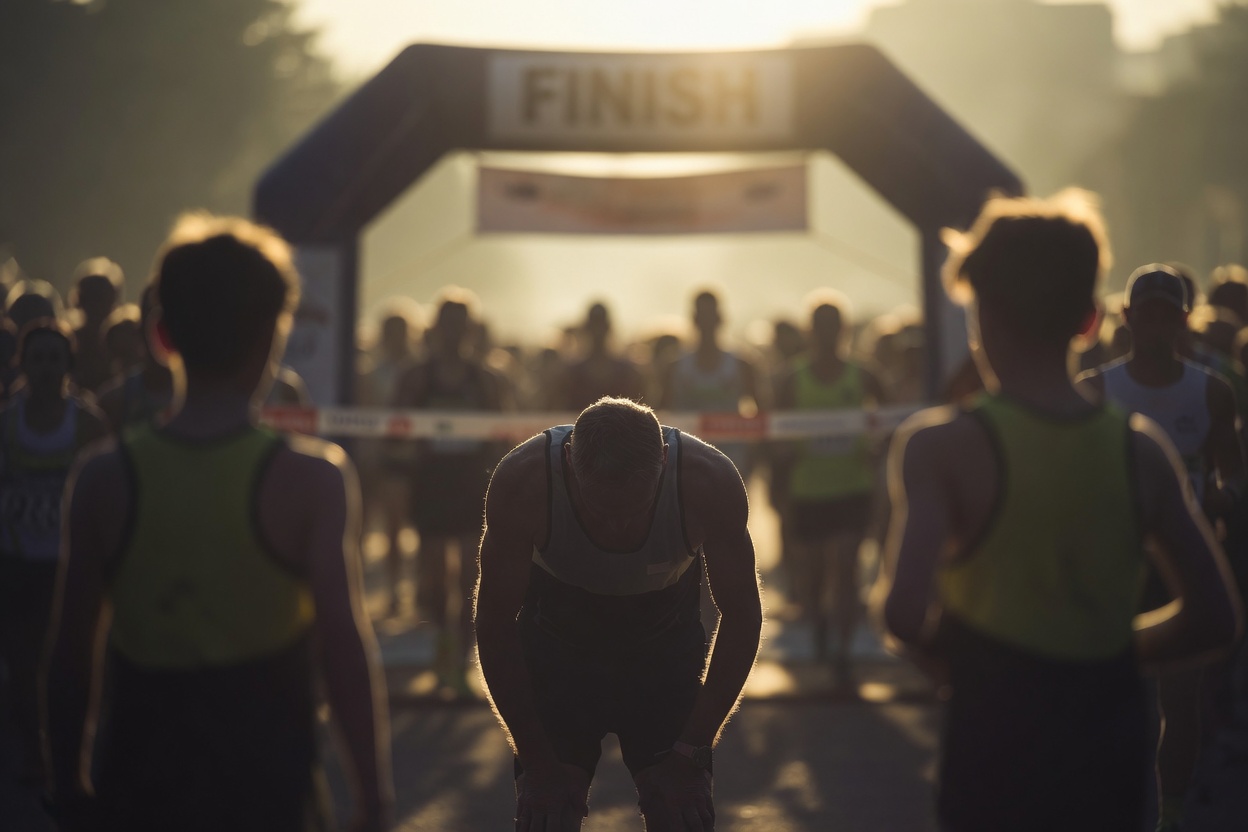
In 2025, Billy ran four marathons in twenty-four hours alongside them: two teenagers, running with their father for a mother they barely remember, raising money for Cancer Research UK in her name. When asked why he runs, he doesn't talk about training. He talks about Kate.
Nearly one in two of us will develop cancer in our lifetime. Caught early, the odds of surviving are ten times better. That gap, between 95% and 5%, is the gap Billy Boyle has spent a decade trying to close.
Kate knew there wasn't a stage five. The test she needed is being built now, by the man who loved her, carried across finish lines by the boys she wrote it all down for.